ATKD-223
Legendary Compilation! JK Confinement & Gangbang Masterpiece 007
Attackers2014.09.04
★4.0(2)
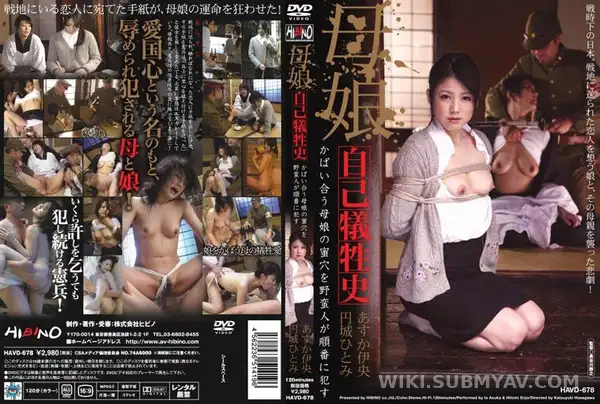
 Io AsukaHitomi Enzyou
A letter to a soldier at war puts a mother and daughter in the hands of brutal military police. They are subjected to sadistic acts, and as they try to protect each other, the situation spirals into further depravity.


Instead of making a poorly executed period piece, it would have been better to just make a modern-day exploitation film. Using modern devices for things like simultaneous mother-daughter rape would have added much more intensity; this film just wastes too many male actors without any real impact. I'm giving it 4 stars only because of the actresses' charm.
Io Asuka was pretty good in 'Kunoichi Torture Abuse 5', so I looked for her other works and discovered she had also performed in hardcore abuse scenes under the same director, Hasegawa. To top it off, the second half features her being tormented with fundoshi play just like in 'Kunoichi...', which was a huge win! Unlike her co-star Yuna Mizumoto, who was so embarrassed she actually stained her fundoshi, Asuka accepted the torture quite calmly. I guess she was already used to it from being subjected to so much fundoshi torture before.
A compelling work centered on the illicit thrill of a mother and daughter choosing to be violated to protect their family and lovers. The humiliation and sorrow of having to submit despite their unyielding spirit come through vividly. While the cover suggests Io Asuka is the lead, Hitomi Enjo’s screen presence is superior. She embodies a realistic, grounded mother figure, and her performance while being violated to protect her daughter feels refreshingly authentic rather than typical AV fare. Her resolve to accept her fate for survival is genuinely impressive—it makes you realize that 'mothers are strong,' even in a production like this. Io Asuka’s performance is undeniably erotic, but the directorial choice to have the mother (Enjo) leave during the final scene is questionable. While it makes for a cleaner, more organized visual, it’s a bit disappointing given how well the mutual protection dynamic was established earlier.